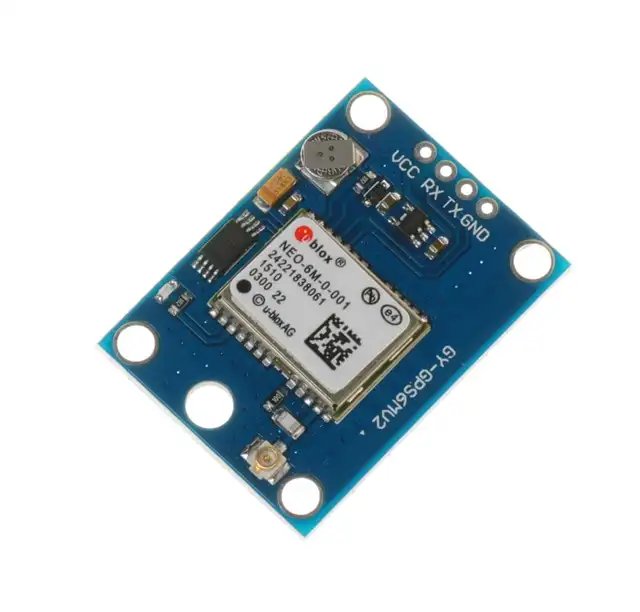
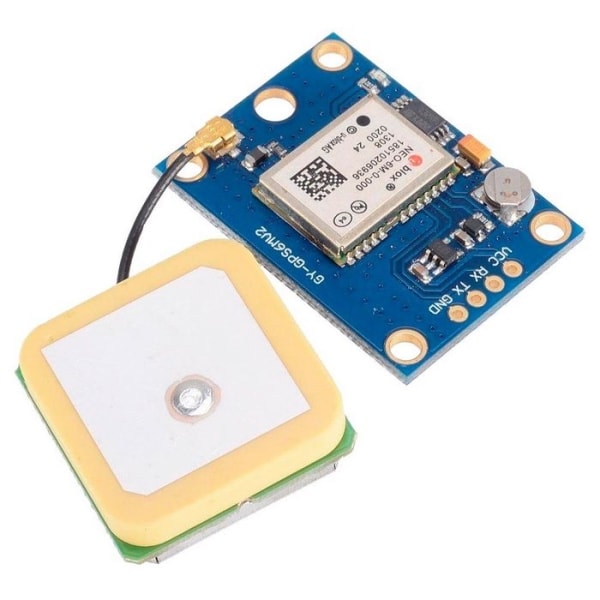
The NEO-7M GPS Module, powered by the u-blox 7 GNSS engine, is a high-performance GPS receiver designed for accurate positioning and navigation in diverse applications. Featuring 56 channels, it supports GPS, GLONASS, QZSS, and SBAS systems, delivering exceptional sensitivity with a tracking capability of -161 dBm and an acquisition sensitivity of -148 dBm. This module provides position updates at up to 10Hz, with a cold start time to first fix (TTFF) of approximately 27 seconds, a warm start of 25 seconds, and a hot start of just 1 second, thanks to its rechargeable backup battery. Housed in a compact 25x35mm form factor with a molded plastic case, it includes an active circuitry ceramic patch antenna for superior signal reception, outperforming older NEO-6 series modules.
Operating on a supply voltage of 3.3V to 5V DC (or via USB cable), it consumes around 45mA and communicates via UART with a default baud rate of 9600 (configurable up to 230400 bps). The module features a built-in EEPROM to store configuration settings and an I²C interface for compass integration (e.g., HMC5883L in some versions). It achieves a position accuracy of 2.5m CEP (up to 0.01m with SBAS) and is preconfigured for 38400 baud with APM/Pixhawk systems, including 6-pin and 4-pin cables for GPS and compass connections. Ideal for drones, robotics, vehicle tracking, and geocaching, it pairs seamlessly with Arduino using digital pins (e.g., TX to pin 5, RX to pin 6) and the TinyGPS++ library for parsing NMEA data. This RoHS-compliant module operates from -40°C to +85°C and weighs approximately 10-15g.
Note: It performs best outdoors with a clear sky view; indoor use may require an external antenna, and the NEO-7M is EOL, suggesting consideration of newer alternatives like NEO-M8N for future designs.