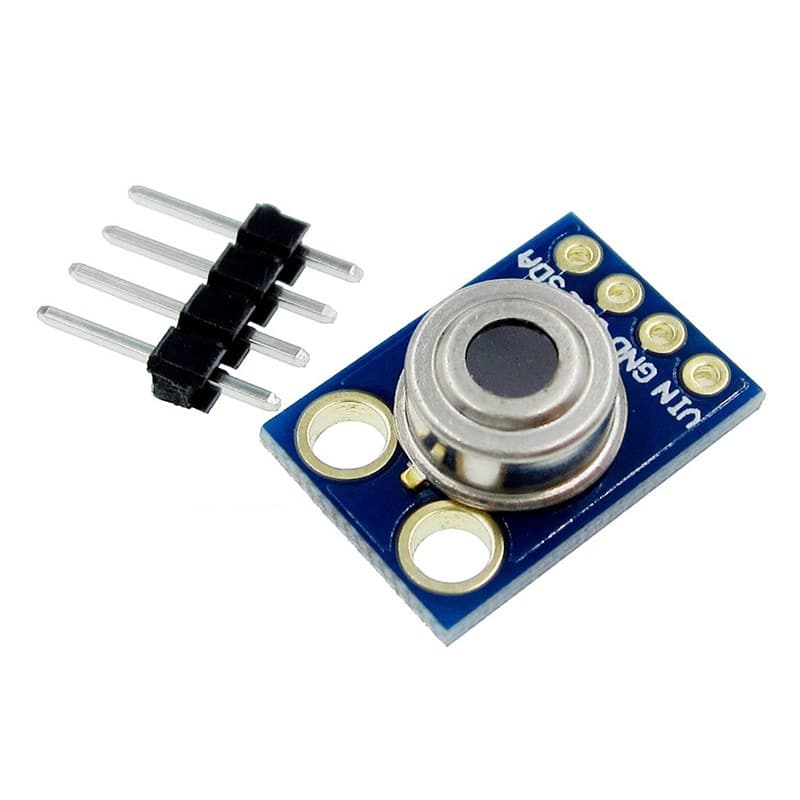
The GY-906 MLX90614ESF Infrared Non-Contact Temperature Sensor Module is a high-precision device based on the Melexis MLX90614ESF-BAA IC, designed for accurate non-contact temperature measurement. This module measures object temperatures from -70°C to +380°C (-94°F to +720°F) and ambient temperatures from -40°C to +125°C, with an accuracy of ±0.5°C within the 0°C to +50°C range and a resolution of 0.02°C. Utilizing a thermopile detector with an integrated signal-conditioning ASIC, it features a 90° field of view (FOV), making it suitable for monitoring moving objects or surfaces like motor shafts or conveyor belts without physical contact. The module operates on a 3-5V supply, includes a 3.3V voltage regulator and pull-up resistors for I2C communication, and consumes less than 2mA during operation.
Equipped with an I2C interface (default address 0x5A), it supports SMBus compatibility and offers customizable PWM output for continuous readings or a thermal switch mode with a programmable trip point. The compact 16.8x11.46x6.2mm board includes a 2cm sensing distance (for the ESF version), making it ideal for close-range applications like medical diagnostics, industrial temperature control, or home automation. For Arduino or Raspberry Pi use, connect VIN to 3.3V or 5V, GND to ground, SCL to the I2C clock line (e.g., A5 on Uno), and SDA to the I2C data line (e.g., A4 on Uno), then use the Adafruit_MLX90614 library for easy integration. It excels in environments from -40°C to +85°C (sensor rating) and is widely used for body temperature measurement, HVAC systems, and livestock monitoring.
Note: Calibration may be needed for optimal accuracy, and the sensor should be kept clean and protected from dust to maintain performance.